Life Cycle Assessment
Everything and everyone leaves an environmental footprint behind. Measuring your own tracks is limiting, but here you can read about the process of certifying a product with an EPD, the standardized life cycle assessment that everything starts with.
Sarek Table
For a life cycle assessment (LCA) to be certified with an Environmental Product Declaration (EPD), it must follow standardized methods, allowing for comparisons of environmental impact. Emissions are stated in kilograms of carbon dioxide equivalents (kg CO₂e) to include the impact of different greenhouse gases. Methane (CH₄), which can be emitted in upstream processes and waste management, has approximately 28 times the warming potential of carbon dioxide, making it particularly important to consider in climate calculations. Below is our example with the Sarek table.
Upstream
In an EPD, the upstream process covers all activities before the production of a product begins. This includes extraction and processing of raw materials, energy use, transportation, and pre-treatment of inputs. Chemicals and other resources used in the raw material process are also included.
Example: For plywood, the upstream process includes logging of trees, transportation to sawmills, wood drying, and glue production. It also includes the energy consumption and chemicals used in gluing and treating the wood before further processing.
Lundbergs Furniture - Production
In an EPD, the production process covers the steps where raw materials are transformed into a finished product. This includes processing, assembly, surface treatment, and quality control. Energy use, chemicals, and waste management are also included.
Example: At Lundbergs Furniture, this means that wood is processed, surface finishes of various materials are assembled, and plywood and solid wood are surface treated with water-based varnishes or oils before quality control and packaging.
Transport
Transportation of materials and products throughout the product's life cycle, including the shipment of raw materials to the factory, distribution of finished products, and any transportation during waste management.
Example: At Lundbergs Furniture, wood is transported from suppliers to the factory in Tibro, where finished furniture is then distributed to retailers and customers.
Use
In an EPD, the use phase covers the environmental impact that occurs during the product's lifetime, including maintenance, cleaning, and repairs. For furniture, this can mean the care of wood surfaces with oils or varnish and any repairs to extend the lifespan.
Example: At Lundbergs Furniture the use phase may include regular care of wood surfaces to maintain quality and reduce the need for new production. In an EPD-based life cycle analysis, a reference lifespan, such as 15 years for a table, is often used to standardize the environmental impact in the calculations.
Waste Management
In an Environmental Product Declaration (EPD), the waste management phase covers the processes that occur when a product reaches the end of its life cycle, including disassembly, sorting, recycling, and final disposal.
Example: The Sarek table is designed for easy disassembly, facilitating reuse and recycling. When the table is no longer used, the wood components can be recycled or converted into energy through combustion in heating plants. Metal fittings, such as screws and fasteners, can be sorted out and recycled as scrap metal, reducing the need for new raw material production.
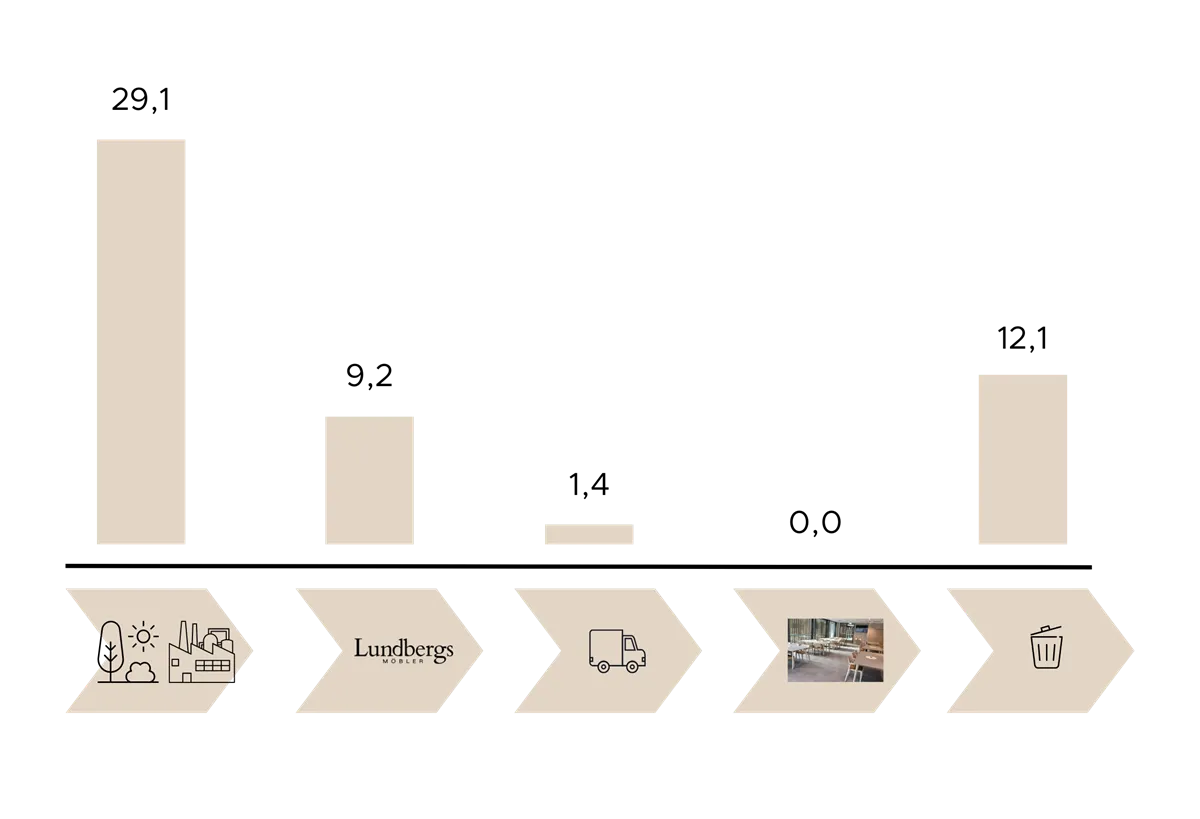
Total environmental impact 51.8 kg CO₂e
Below, the distribution of total emissions can be seen, divided into respective stages in the life cycle where they are created. The bars are shown in kg CO₂e.
Summary
The bars show the environmental impact in kg CO₂e for each process in the linear life cycle. The data is sourced from the EPD for the table SAREK with dimensions H730, L1400, W750 mm.
Greatest during raw material extraction & waste management
The relationship between the bars is no coincidence – in many cases, the environmental impact is greatest during raw material extraction and waste management in the linear life cycle.
From linear to circular life cycle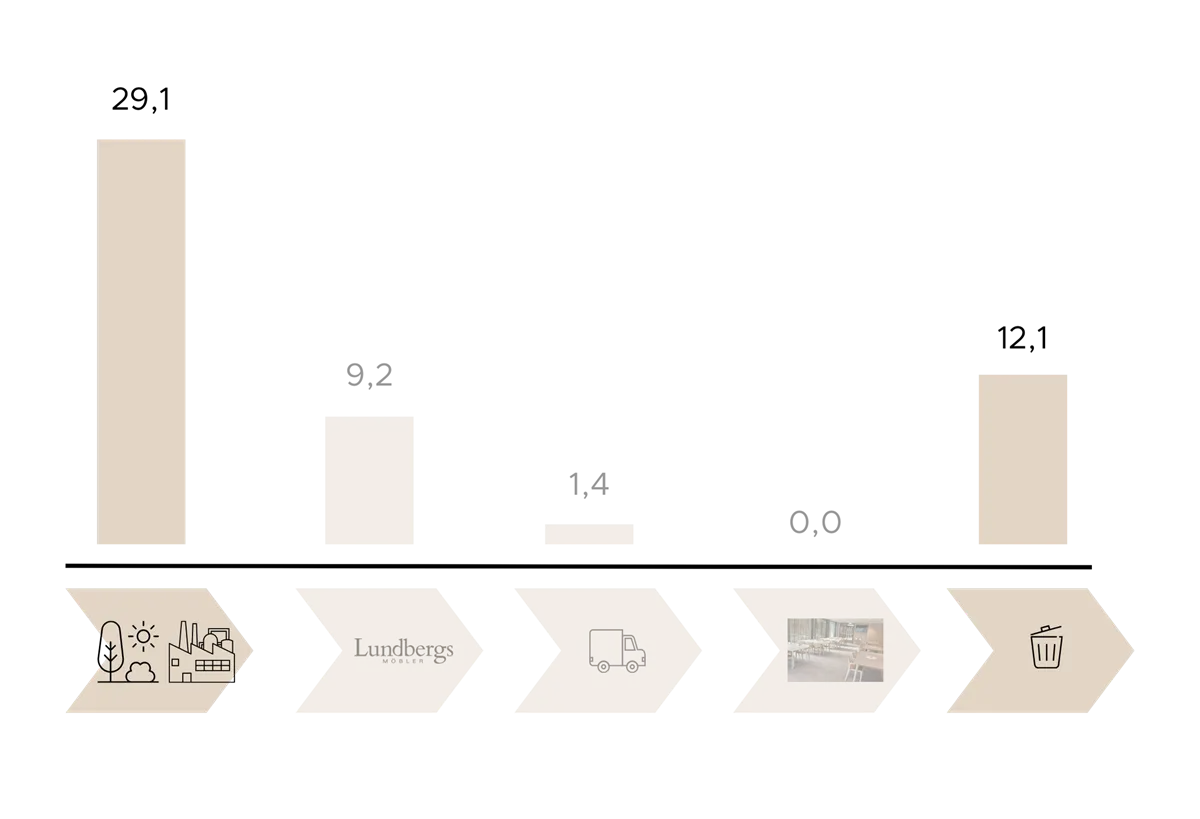
Furniture example
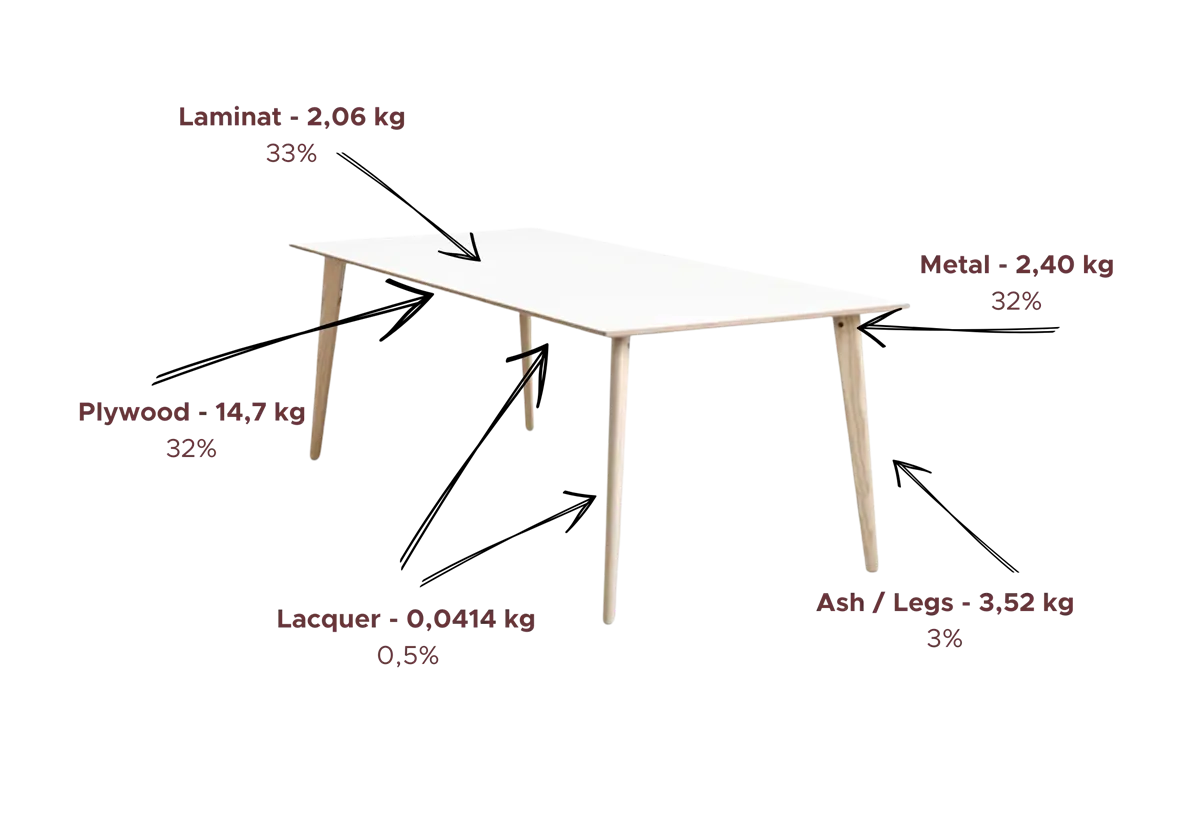
A closer analysis of the materials causing emissions in the upstream processes shows clear differences in their environmental impact.
How surface finishes affect the environment